I'm new to this forum and just wanted to say hi to all. I'm an amateur artist from Finland, and my subjects include military history and passion to the Great War. My works can be found from my DeviantART-account: http://patriatyrannus.deviantart.com Here are couple of my tank-related pieces for you to view:
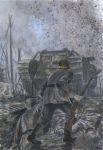
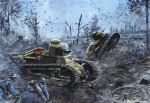
Not Leaving You Behind (acrylics 2009) re-do of my old ink drawing, featuring a German soldier helping his wounded comrade in the face of an attack.
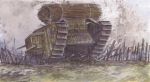
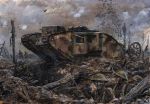
Ramming Through (acrylics 2009) British Mk IV tank, C48 "Caesar" advancing on November the 20th 1917, during the battle of Cambrai.
-- Edited by Landsturm on Friday 30th of April 2010 08:58:08 AM
-- Edited by Landsturm on Friday 30th of April 2010 09:47:57 AM
Of course :) feel free to view my gallery for more of my artwork. Assuming you specifically mean "do more tanks"? Is there some specific type, individual or situation in mind?
Your gallery is really great! OK, so you've done two paintings with British tanks, how about German A7V tank or other tank/armoured car/armoured train of the Great War?
Or one of two fights between tanks in the Great War: Villers-Bretonneux (A7V vs Mark IVs, later A7V vs Whippets) or Niergnies/Seranvillers (8th October 1918, German Mark IVs vs British Mark IVs)
I just might :) I'm always trying to view the war from several point of views and sides. I have the Kenneth Macksey's "Tank versus Tank" in my bookself, which has good battle accounts and maps about those. But is there ONE specific idea you got? At the moment I have tons of work in my hands, but I'm always asking what people want to see, just don't hold your breath ;)
I think that making a nice painting of a fight between two or more tanks is really hard so a single A7V (I just love these tanks) would be great for a beginning
I didn't hear about "Tank versus Tank" book. Does it contain information on WWI battles? I guess that Villers-Bretonneux is covered, but I'm not so sure in case of much less known Niergnies/Seranvillers. Many people think that Villers-Bretonneux was the only tank vs tank fight of WW1.
"Tank versus Tank" was very informative book and I hadn't heard about Niergnies before this. It contains a map, history and battle accounts starting from WW1, goes through WW2, Cold War and ending up in the near-future scenario (well, maybe a late 1990s) of armour vs. armour. I recommend it.
I'd like to see a painting of the Mk IVs as they first came into Nixe's veiw, or possibly A french heavy tank. And as everyone knows, A7Vs are welcome!
LinkonTanker : DON'T use Deviantart. I used to be a(n active) member (I drew uniforms, but stopped since everyone else was too interested in anime), and found that whenever you searched something to do with history it either came up with something totally random and out of contex, or some kind of insult to both art and history in, once again, form of anime, as drawn by strange Japanese school girls. If you want real art, don't bother with Devart.
-- Edited by Hughbearson on Thursday 13th of May 2010 07:56:24 PM
DA is not without its flaws, but I've find it useful for presenting my works and also receiving some good critique. I agree with you, but I'm not interested in anime and I ignore them, as well as all the other styles, genres, influences and groups that I'm not interested in.
More great work indeed. The whole gallery is great, and much of it captures the emotional aspect which is a fitting tribute to those who fought - and those who died. "Lest we forget."
Back to topics - one thing that has haunted me ever since I read it (somewhere, I can't find it again), that at (such-and-such) a battle, the Germans first used the tactic of firing flares at the tanks in the fog, to mark them for artillery attention. What a surreal scene - I haven't seen it pictuered anywhere, but it would be difficult to portray. Perhaps other forum members know, or have an idea, which battle that might have been and which formations might have been targeted that way?
Forgot about this forum I started a new series of paintings on the subject.
Â
In the middle of the battle of the Somme, September 15th 1916 marks the first use of "tank" in warfare.  Here, a British Mark I tank C5 "Crème de Menthe" arrives to support the Canadian troops near the Sugar Factory on their way to Courcelette. Out of the six tanks operating here, only C5 (despite the broken steering tail wheel) and C6 managed to get to their objective and back. The others broke down or got stuck in the no-man's land.
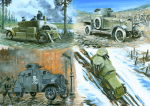
the First World War saw a great number of different armoured cars, before and after the first tanks appeared in the battlefield. Here are just a few examples used;
Top left: Belgian Minerva car patrolling on the outskirts of a German occupied town, August 1914. Top right: British Rolls-Royce Mk I, in Egypt, 1916. The upper panels of the armour has been removed from the turret, as it was often the case in desert regions. Lower left: After the war, German E-V/4 Panzerkraftwagen Ehrhardt being used by the Freikorps in Berlin, during the uprising January 1919. Lower right: Russians decided to produce a domestic version on the chassis of British Austin. Due the revolution of 1917, the "Russian Austins" didn't quite make it to the WW1. But it was extensively used in the following Civil War and the related conflicts, especially by the Reds. This car became known as Austin-Putilov.
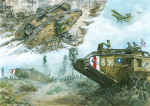
Mark tanks in both desolate quagmire and open country in the Western Front.
Top inset: Female version of Mark IIC21, 578 named "Perfect Lady" during the Arras offensive. This particular tank had ditched before reaching the British frontline on the opening of the attack on 9th April 1917. It was in action once again two days later, but it's destiny was to be knocked out by a friendly artillery barrage in Monchy-Le-Preux, on 11th April. Although considered a British "victory", the Arras offensive (together with the ill-fated French offensive at the same time) didn't achieve a breakthrough and resulted high casualties.
The year 1918, saw the armoured warfare at its best. In the foreground, Mark VB56, 9003 of the (C Coy, 2 Battalion, Tank Corps), while advancing in support of the Australian troops in Amiens, 8th August 1918. This was the start of a final Allied offensive and the opening day led Ludendorff to name it "the black day of the German Army".  This battle was also the debut of a lengthened model, Mark V*, that can be seen in the background accompanied with infantry.
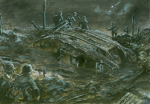
the Mark IV was the most produced British tank of the war. Introduced in early summer 1917, they were used in the famous battle of Cambrai, later that year. But before that, they were also deployed in the notorious Third battle of Ypres.
Depicted is one remarkable incident. On 22nd August 1917, tanks of 18th Company (F Battalion) were making an attack against series of fortified farm buildings. After engaging the enemy positions named "Somme Farm" and "Gallipoli", one individual F41 "Fray Bentos" stumbled into a shellhole and got stuck in the mud. And, as we now, mud was sort of the "thing" of Third Ypres. The tank remained ditched in no-man's land, with casualties, under fire from both sides and fighting off three German counter-attacks until the crew abandoned the tank and managed to get back to their own lines on the night of the 24th. The remaining crew received several awards for this action. The commander, Captain Richardson (now a recipient of a Military Cross) would fight later at the Battle of Cambrai, in a tank named "Fray Bentos II". This vehicle was also put out of action and captured by the Germans. Richardson's son was killed while serving in the Royal Tank Regiment, at El Alamein 1942.
Â
That's what I have so far. I'll add more over time...
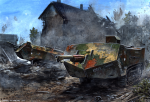
As their Spring offensives continued onto early summer, Germans launched "Operation Gneisenau" against the French and Americans, in June 9th 1918. In Compiègne, the French (under General Mangin) started their counter-attack with four divisions and 160 tanks, surprising the Germans and eventually stopping their offensive.
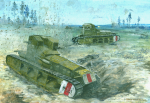
Section of Whippets from 3rd Battalion (Tank Corps) was tasked to aid the New Zealand Division against the German machineguns east of Bapaume. While under intense fire, one tank (A233) slipped into a shell hole and caught fire, trapping the crew inside. Lieutenant Cecil Sewell, commanding A259 "Caesar II", stopped his tank and ran out across open ground under enemy fire and managed to rescue the crew. After this, while attending to his own wounded driver, Lt. Sewell and his gunner were both killed. For this action, Lt. Sewell was awarded posthumous Victoria Cross.
Germans armoured force was mostly made of captured vehichles, like the British Mark IV.
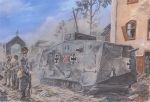
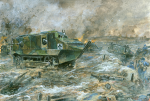
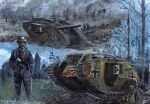
Top: German armour, both the captured Beutepanzers and German-made A7V's, first saw action in the beginning of Kaiserschlacht. On 21st March 1918, as the German started their "Operation Michael", female tanks "Käthe", "Lissy", "Hedda" and "Sonja" from Sturmpanzer-Kraftwagen-Abteilung Nr. 11 supported the German IX Corps's attack against the British in St. Quentin. The tank is painted with Maltese cross on the hull side for recognition. Later on the insignia and vehicle numbers would become more elaborate. Left: German tank crew member. Bottom right: After the Spring offensives and battles of summer 1918, the Germans found themselves on retreat and with the end of war in sight. Here a German tank, from Schwere Kampfwagen-Abteilung (Beute) Nr. 15 is waiting for orders of counterattack at Niergnies, 8th October 1918. This was to become the second (and the last) tank versus tank battle during the First World War, as they unexpectedly encountered the British Mark IV's. The battle was made chaotic due fog and smoke, and first the British mistook the opposing tanks as their own. The German tank has a camouflage coloration ans has switched to a new Balkan cross markings painted from early October 1918 onwards.
The Allied �Hundred Days Offensive� continues to the Hindenburg Line. The French and US offensives in Champagne and Argonne had started in late September.
Yes, beautifull painting, but some historic mistakes . . . . .
The Schneider M1 from S/Lt Payotte was turn, more on the left, just behind the Schneider from Cne Beltz (the tank inside the German trench),
With a double towing cable, between the two tanks, the Schneider from S/Lt Payotte was not able to tow the tank out of the first German line.
See on this topic : https://forum.pages14-18.com/viewtopic.php?f=34&t=52940
Schneider n° 61057 (ace of clubs) was the third tank from second Battery (ace of clubs), and 61228 was
The Schneider from Groupement Chaubès, destroyed in front of the French first line, was not unable to cross this line but, just returned on orders, behind the first French line.
It was not enough to saved it from German artillery, adjusted since the "Plateau de Californie" upon Craonne.
            - No protection, by French Air Forces, of the tanks against observation aircraft and balloon.
            - No control and no action against artillery observation posts from Plateau de Californie, spot high 108 and right bank of the Aisne.
All these points, not raised, before the attack, in the Army and Army Corps orders was, inside all reports from these High Command