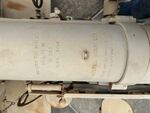
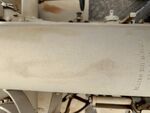
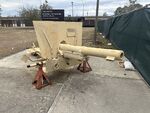
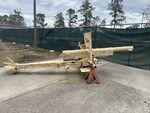
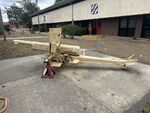
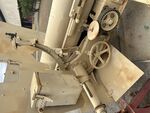
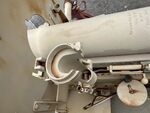
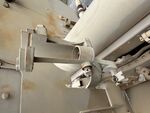
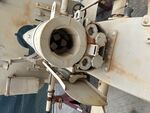
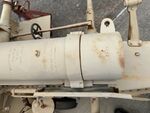
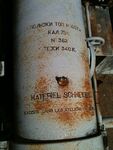
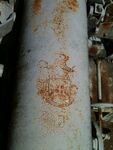
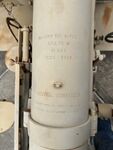
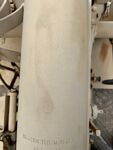
Well, this is a topic that sparked a bit of lively debate a few years ago. Let‘s see how it goes this time. This a French manufactured 75mm M1907A exported for Serbian service. The 75mm M1907 was designed by Scheider but this example was manufactured by Saint Chamod. It was captured by Ottoman/Turkish forces and apparently continued into their service. It was located in Iraq up to 2007, and was gifted to 1-41 Field Artillery, US Army. It is located at Fort Stewart, Georgia, USA. It is not available for the public to see because it is displayed on an active US Army post. However, I was able to take these photos yesterday. The unit had paid for good reproduction wheels after it came in from Iraq in 2008 or so. Unfortunately, later commands of the 1-41FA failed to care for the gun and wheels so they are now unusable. It is displayed on jacks today for this reason. It is quite a rare piece, especially in North America where I know of no other example. I hope the photos are enjoyed and are valuable for the study of this gun. This is a link for a few detailed drawings of the 75mm M1907: https://www.lovettartillery.com/MAT_French_75mm_Schneider-Canet_M_1907_DETAIL_.htm And it’s Caisson, I do not have details of its Limber: https://www.lovettartillery.com/MAT_French_75mm_Schneider-Canet_M_1907_CAISSON_DETAIL_.htm
-- Edited by Ralph Lovett on Saturday 31st of January 2026 11:04:54 AM
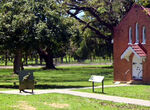
The only other 75mm Schneider field gun from the Ottoman captured (hijacked?) guns seems to be at Victoria Plantation, Ingham, Queensland, Australia.
There were 52 Schneider guns seized by the Ottomans at the port of Salonika while being shipped to the Serbian Army in 1907. The Schneider guns used the same size ammunition as the 75mm Krupp guns already in service with the Ottoman Army and seem to have been used interchangeably with 75mm Krupp export guns.
This example (#340) was built at le Creusot, Schneider's main plant.
The inscription is in Serbo-Croation and since it was intended for the Serbian Army the script is Cyrillic, the line at the top reads "Field Gun M 1907A"
The Schneider guns were inscribed with the emblem of Serbian royal house but it looks like that's vanished under paint and crud on the US example.
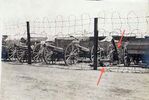
It's speculated that at least two Schneider guns were captured after the Ottoman retreat from Beersheba, Palestine in Nov 1917 - there is photographic evidence of this.
Charlie
-- Edited by CharlieC on Saturday 31st of January 2026 10:23:58 PM
-- Edited by CharlieC on Saturday 31st of January 2026 10:29:48 PM
-- Edited by CharlieC on Saturday 31st of January 2026 10:30:17 PM
Great information. I had no idea the 75mm M1907A could use Krupp 75mm ammunition. I am puzzled by the "Saint Chamond" markings on the example here in the USA if the Scheider Creusot plant manufactured it.
Great information. I had no idea the 75mm M1907A could use the Krupp 7,5cm ammunition. Yes, the Serbian crest is on this example and if you look closely, it is under the tan paint in one of the photos I submitted. Also, interesting that there were multiple manufacturers of the Schneider 75mm M1907.
R/
Ralph
-- Edited by Ralph Lovett on Sunday 1st of February 2026 03:09:11 AM
The Bulgarian artillery website (https://www.bulgarianartillery.it) says the Serbs ordered 320 Schneider field guns which were delivered in two batches from 1908. The later 160 guns were slightly modified compared to the earlier order and were known as the M1907A version.
There is a drawing of the Schneider limber at - https://www.bulgarianartillery.it/Bulgarian%20Artillery%201/Deposito_Varia/Equipments/0S75mmQF_gun%20limber.jpg. This seems to be the Bulgarian version but the Serbian one was probably identical.
I suspect that Schneider had to sub-contract the construction of the 75mm field guns due to lack of production capacity. The 75mm Schneider guns were not built in large numbers so the capacity allocated to them by Schneider would have been modest at best. Saint-Chamond had experience building light field guns since they had built the Mondragon designed 75mm for Mexico in the same time frame.
The manual for the 75mm M1912 is on Gallica: https://gallica.bnf.fr/ark:/12148/bpt6k6556658x/f128.item. I believe the M1912 used by the French cavalry had the breech modified to use the 75mm Mle 1897 ammunition.
I've attached the Google street view of the M1907A at Victoria Plantation, Ingham. The church was built in 1922 as a memorial to the fallen in WW1.